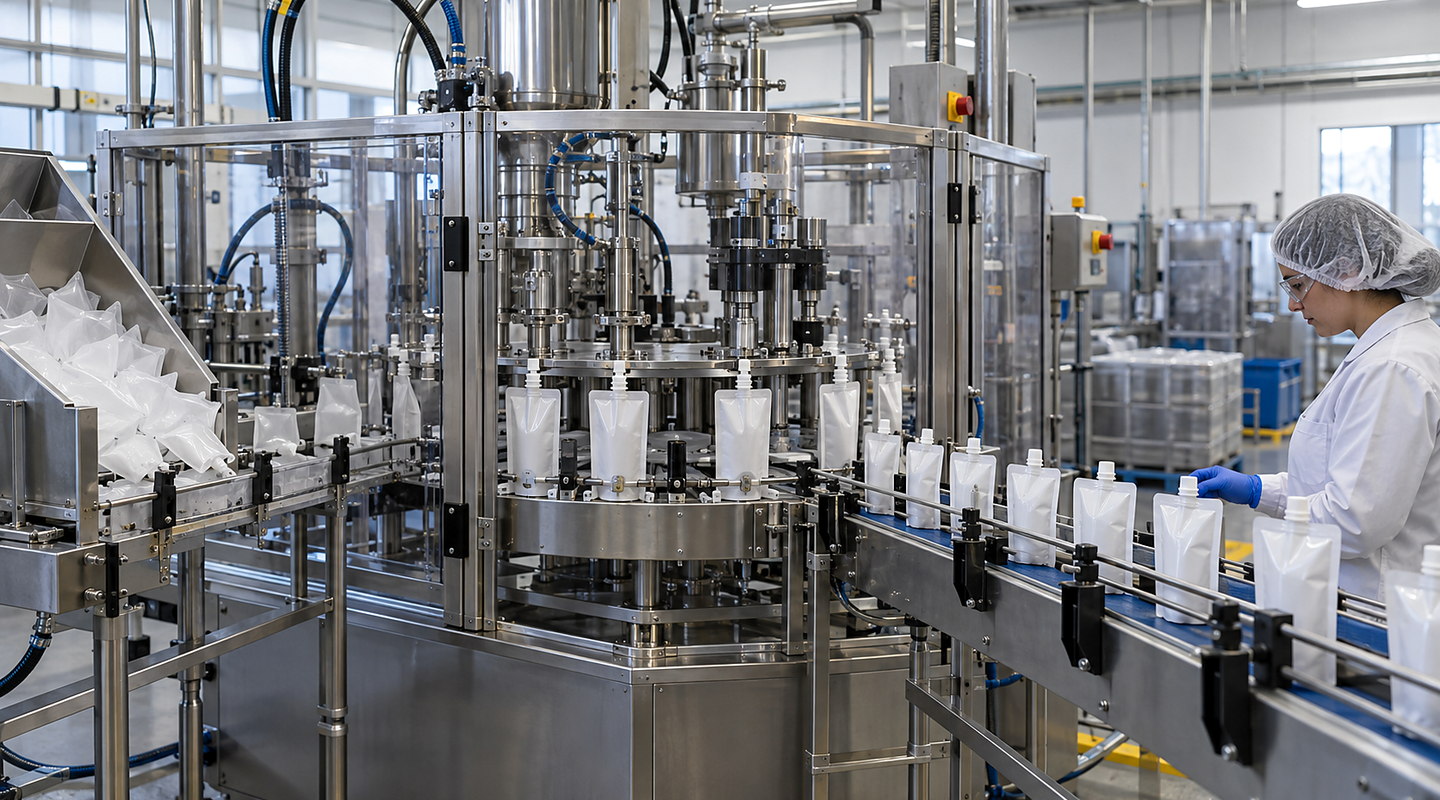
Premade Pouch Packers Selection Guide
Compare premade pouch packers using actual pouch construction, opening, product and closing trials. Include replenishment, format changes and accepted-pack output.
Compare premade pouch packers using the actual pouch construction, opening and gripping areas, product condition, fill size and required finished pack. Trial pickup, a sufficiently open product path, dosing access and the closing area as separate decisions.
Use the pouch-format sample review and complete operating sequence when comparing semi-automatic work, automatic integration and a roll-film alternative. Apply the same accepted-pack definition and include handling and changeover work.
Compare options in the conditions where they must work — Premade Pouch Packers
Plan premade pouch packers around your product, pack range, target output, cleaning needs and finished-pack checks. Discuss a practical line concept with Lancing using representative samples. A useful shortlist should show how every option copes with premade pouch opening, filling & sealing product behaviour and cleaning, access and changeover method.
Discuss your application
Ask every supplier the same questions
| Decision | What to ask | What to check |
|---|---|---|
| Pouch supply and construction | Which supplier batches, stack condition, curl, gusset and closure features must the trial represent? | Identified production pouches, drawings, loading method and missing/doubled/skewed examples. |
| Opening and filling access | What establishes a sufficiently open mouth before a dose is released? | Opening/gripping area, chute/nozzle clearance, incomplete-opening response and highest-fill/smallest-mouth trials. |
| Product and fill size | How do product condition and the approved dose range affect entry and the future seal area? | Representative product, individual quantity observations and separate spillage/seal-clearance records. |
| Completed-pack output | What job mix, replenishment, stops and change frequency must the comparison include? | Accepted completed packs, rejected/unconfirmed packs, interventions and the agreed run conditions. |
| Cleaning and format change | Which approved clearance tasks, guides, grips and dosing/closing settings change? | Responsibility, change parts/settings, first-off checks and remaining product/hygiene validation boundaries. |
| Finished-pack and exception checks | How are opening, quantity, closing and part-completed packs assessed separately? | Stage-specific criteria, retained failures, hold/reject decisions and records closing each unresolved case. |
Include simpler approaches to premade pouch opening, filling and sealing in your shortlist
| Approach | Often suitable when | Watch for |
|---|---|---|
| Defined premade-pouch route | The finished empty pouch construction and product/format range are agreed. | Prove supply presentation, opening, dosing access and closing with representative production samples. |
| Semi-automatic operating route | Lower volumes, varied jobs or manual pouch presentation may justify operator involvement. | Include pouch loading/opening, filling, closing, checks, replenishment and approved clearance in accepted output. |
| Automatic integration or roll-film comparison | Repeatable pouch flow may support wider integration, or a roll-film route may merit comparison against the required pack. | Use the same product, finished presentation and accepted-pack definition; include exceptions, format work and connected equipment boundaries. |
Pause before choosing when…
- Only perfect or hand-selected examples of routine production using premade pouch opening, filling and sealing are available.
- No one has defined how finished-pack checks and reject handling will be evaluated.
- The normal range for premade pouch opening, filling & sealing product behaviour is described only as “usually fine” but has not been bounded.
- Your operator, cleaning, maintenance or recovery access has not been considered.
- Quoted performance depends on another machine or data source that is not included.